
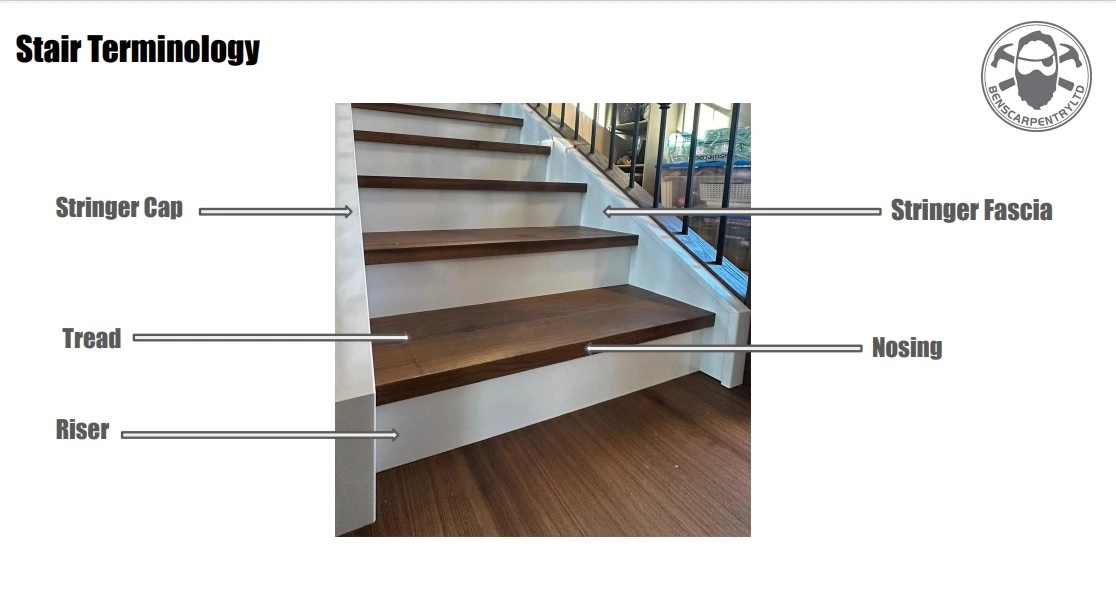
Most people have never had a reason to learn what a stringer is. Then a carpenter is standing in your hallway using five words you've never heard, and you're nodding along. Here's the whole vocabulary on one photo.
- Tread
- The flat, horizontal surface you step on. In the photo these are the dark hardwood boards. Treads take all the wear on a staircase, which is why the material you pick for them matters more than anywhere else on the stairs.
- Riser
- The vertical board that closes the gap between one tread and the next. In the photo the risers are painted white against hardwood treads, which is a common contrast in Edmonton homes. Open-riser staircases leave this piece out on purpose.
- Nosing
- The front edge of the tread, where it projects out past the riser below it. The overhang gives you a little more foot room on each step and finishes the edge cleanly.
- Stringer
- The board running up the side of the staircase that carries the treads and risers. It's the structural spine of the stairs, and it's the part homeowners almost never have a name for.
- Stringer cap
- The finished top edge that caps the stringer and runs up alongside the steps. It's the piece your hand or your vacuum brushes against on the open side of the stairs.
- Stringer fascia
- The flat finished face on the outside of the stringer, the panel you see from the room. Cap and fascia together are the visible half of the stringer, which is why they get finished while the structure behind them doesn't.
Tread, riser and nosing do different jobs
These three make up the step itself, and they wear differently. The tread takes every footfall, so it's the piece that decides how your staircase ages. The riser barely gets touched, which is why it's so often painted while the tread is stained hardwood.
The nosing is the detail people notice last and miss most. Without that overhang a step feels shallower underfoot, and the front edge of the tread has nowhere to go but a hard square corner.
The stringer is the part doing the work
The stringer carries the whole staircase, but you only ever see two parts of it: the cap along the top and the fascia on the side. Those are the surfaces that get finished to match the rest of the woodwork.
That split is worth knowing when you're pricing a job. A staircase that needs new cap and fascia is a different scope from one where the treads are being replaced and the stringer stays.
The railing has its own vocabulary
Stairs and railings are two different sets of words. The railing brings in handrails, newel posts, spindles and brackets, and each of those comes in enough styles to be worth its own guide.
Rather than repeat them here, the selection guides walk through each part with photos of the actual options: hardwood, handrail, post and cap, spindle, and bracket.
What this looks like when Ben visits your home
Ben builds interior stairs and railings across Edmonton, Leduc, Spruce Grove, Sherwood Park, Fort Saskatchewan and St. Albert. At a consultation he'll walk your stairs, measure them, and talk through what's being replaced and what's staying.
Knowing these five words changes that conversation. Instead of pointing and saying "that bit there", you can say the nosing looks tired, or ask what a new stringer cap would cost, and get a straight answer on the spot.
If your staircase needs work, that's a custom staircase job. If it's only the guard that's dated, that's an interior railing job, and they price differently. Get an estimate and Ben will tell you which one you're looking at.
Thinking about your own stairs or railing?
Send Ben your project details, or a photo, for a no-obligation estimate.
Request a quote